Key Considerations for Designing a Modern and Functional Apartment Living Room
In modern living spaces, apartment living room design is no longer limited to aesthetics alone but has become a comprehensive equation of functionality, emotion, and overall connection. With the constraint of limited floor area, apartment living rooms require careful consideration from the very first step of defining the design style to spatial layout, color schemes, and furniture selection. Join TECO as we review the golden notes that help you own a beautiful, modern, and time-resilient living room.
Golden notes to keep in mind when designing an apartment living room
Clearly define the desired modern style
The first step in designing an apartment living room is to clearly define the main design style. Modern style is not a vague concept but includes various branches such as Modern, Minimalist, Modern Luxury, or Contemporary.
Defining the style from the beginning helps the entire design process follow a clear direction, avoiding uncontrolled mixing of styles. Modern apartment living rooms typically prioritize clean lines, clear forms, and minimize overly elaborate decorative details. Furniture focuses on functionality while maintaining high aesthetic value.
Once the style is clearly determined, the selection of colors, materials, and furniture becomes consistent, creating a harmonious and professional overall space.
 Clearly define the desired modern style
Harmonious colors and lighting
Color plays a vital role in apartment living room design, especially for apartments with small to medium floor areas. Neutral tones such as white, beige, light gray, or light brown are often preferred for their ability to visually expand the space and create a light, refined atmosphere.
Alongside color, lighting is an indispensable factor. Apartment living rooms should maximize natural light through large windows or balconies. Natural light makes the space feel more open and airy while providing a comfortable experience for users.
Artificial lighting should be arranged scientifically, combining ceiling lights, indirect lighting, and decorative lights. Proper lighting design not only meets daily living needs but also helps create depth and visual focal points for the living room.
Reasonable spatial layout
Layout is the “backbone” of apartment living room design. A well-planned layout optimizes usable area, ensures smooth circulation, and delivers a comfortable user experience.
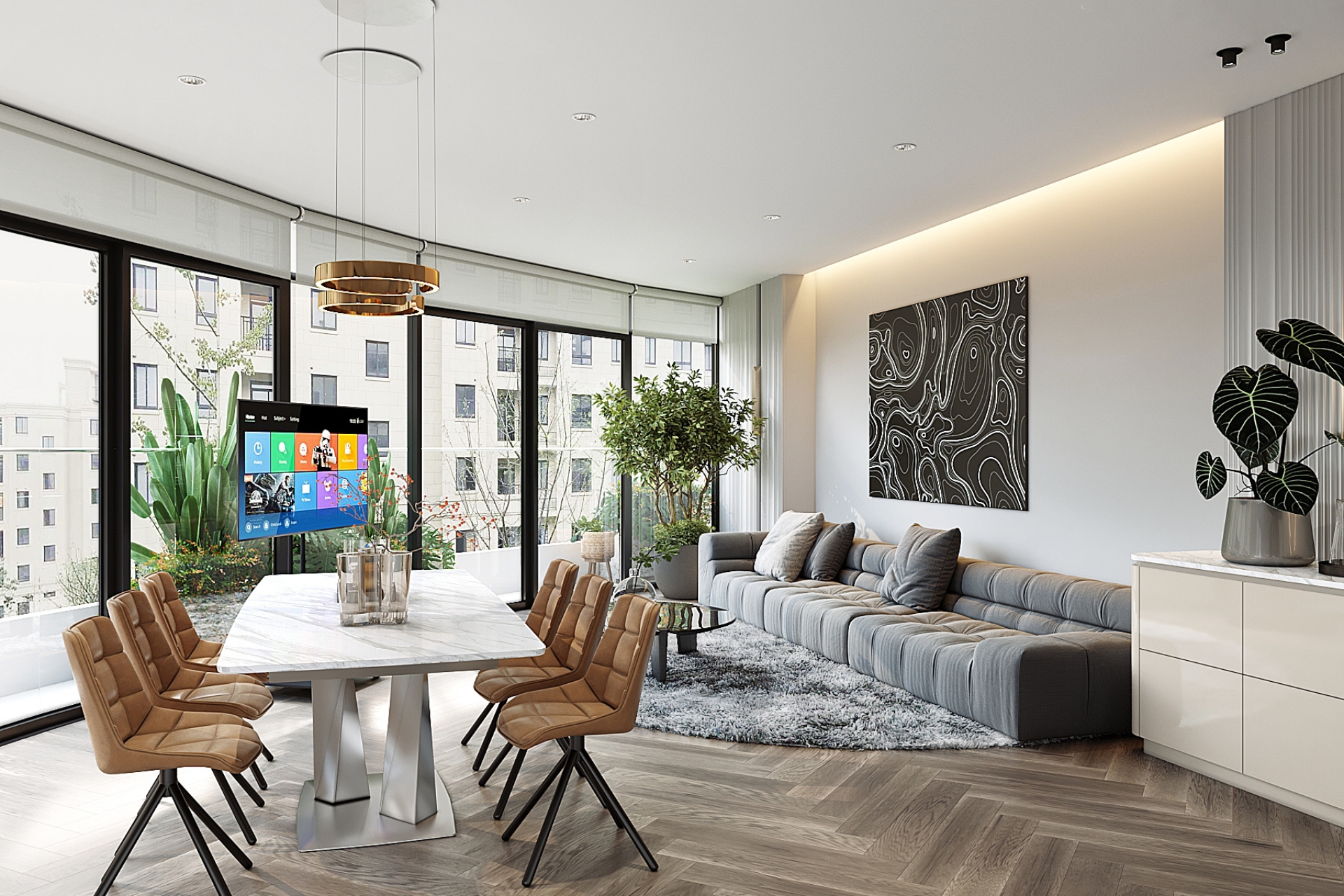
When arranging the living room, it is necessary to clearly define functional zones such as the reception area, entertainment area, and circulation paths. The sofa, coffee table, and TV cabinet should be arranged along a main axis, avoiding scattered placement that causes visual clutter.
For apartments where the living room connects directly to the kitchen, spatial zoning should be handled subtly through rugs, lighting, or color schemes. This approach keeps the space visually continuous while clearly defining functions.
 Ensure a reasonable spatial layout
Creating focal points for the living room
A modern living room can feel bland if it lacks focal points. In apartment living room design, focal points do not need to be overly elaborate but should be carefully restrained.
Focal points may come from a decorative feature wall, a standout sofa set, artwork, or unique lighting fixtures. The key is to limit focal points to one or two main elements to avoid heaviness and visual confusion.
Properly created focal points help express the homeowner’s personality while elevating overall aesthetics without compromising the modern spirit.
Create focal points for the living room
Overall consistency with other spaces
The living room is the central space that connects other functional areas within the apartment. Therefore, apartment living room design must ensure consistency with the kitchen, dining area, and corridors.
Consistency is reflected in design style, main color palette, and material selection. When spaces are closely connected, the apartment feels more harmonious, seamless, and visually deeper.
Especially for modern apartments, cohesive design also enhances aesthetic value and long-term usability for the entire living space.
Common mistakes in modern living room design
Following trends while neglecting functionality
A common mistake in apartment living room design is chasing trends while overlooking actual usage needs. Beautiful but impractical furniture quickly leads to discomfort in daily life.
Modern design must prioritize functionality. Every decision regarding furniture, layout, or decoration should be based on the family’s habits and real needs.
 Avoid following trends while neglecting functionality
Color schemes lacking focal points
Using too many colors or poorly planned color combinations makes the living room look cluttered and shallow. Conversely, using only one monotonous tone can easily feel boring.
The solution is to establish a clear primary color palette, then add accents through contrasting colors or materials to create visual balance.
Furniture not suitable for the space
Oversized furniture makes apartment living rooms feel cramped, while furniture that is too small creates a fragmented space lacking visual anchors.
Furniture in apartment living room design should be chosen in proper proportion, suitable for both floor area and ceiling height. Compact, multifunctional designs are often the optimal choice for apartment spaces.
Ignoring feng shui
Feng shui is a factor many homeowners care about but often overlook or apply incorrectly. Mirror placement, TV cabinet positioning, or circulation paths that conflict with feng shui principles may affect daily comfort and family psychology.
In apartment living room design, feng shui should be considered flexibly, balancing scientific reasoning and aesthetics, and avoiding rigid application that causes inconvenience.
 Avoid neglecting feng shui considerations
Conclusion
Apartment living room design is a refined combination of aesthetics, functionality, and overall coherence. By mastering the golden notes—from style, color, and lighting to layout and focal points—you can achieve a living room that is not only beautiful but also aligned with a modern lifestyle. Avoiding common mistakes is the key to ensuring the living room remains durable, comfortable, and valuable over time. TECO hopes this article has provided you with useful insights related to apartment interior design.