

Comparison Between Precast Concrete Components and Cast-in-Place Concrete: Which Solution Should You Choose?
In modern construction, the selection of structural solutions directly affects project quality, construction progress, and investment costs. The two most common solutions today are precast concrete components and cast-in-place concrete. Each solution has its own advantages and limitations, making them suitable for different types of projects. Join TECO in exploring and gaining detailed insight into these two structural solutions.
 Comparison between precast concrete components and cast-in-place concrete
Precast concrete components – An industrialized construction solution
Precast concrete components are structural elements such as columns, beams, slabs, walls, or panels that are manufactured in factories according to technical designs. They are then transported to the construction site for installation. The production process takes place in a strictly controlled environment, from materials and concrete mix proportions to curing conditions before final products are completed. As a result, component quality is stable and less dependent on weather conditions or labor skill levels.
In the context of the construction industry shifting toward industrialization, precast concrete components are increasingly widely applied. This solution is especially suitable for projects requiring fast construction progress, consistent quality, and high risk control, such as industrial factories.
 Learn about precast concrete components
Cast-in-place concrete – The traditional method
Cast-in-place concrete is a traditional construction method in which formwork and reinforcement are assembled directly on site, after which concrete is mixed and poured into the structure. This method allows flexible handling of complex forms and easy adjustment to actual site conditions.
However, the quality of cast-in-place concrete largely depends on construction workmanship, weather conditions, and curing practices. If the process is not strictly controlled, structural defects may arise that affect long-term durability. Nevertheless, for residential buildings or small renovation projects, cast-in-place concrete continues to play an important role due to its inherent flexibility.
Explore cast-in-place concrete
Comparison of differences between the two solutions
Load-bearing capacity and structural durability
In principle, both precast concrete components and cast-in-place concrete use reinforced concrete. Therefore, load-bearing capacity depends on structural design and construction quality. However, precast concrete components typically achieve higher uniformity because they are produced in factory environments with strict control processes. Stable concrete mix proportions and standard curing regimes help components reach their designed strength.
In contrast, cast-in-place concrete is more prone to deviations if mixing, vibration, or curing processes are not carried out properly. This can reduce structural durability over long-term use, especially for large-scale projects.
Dimensional accuracy
Dimensional accuracy is one of the most noticeable differences between the two solutions. Precast concrete components are manufactured using standardized molds in factories, resulting in minimal tolerances and well-finished surfaces. This allows on-site installation to proceed quickly and significantly reduces finishing and post-construction adjustment work.
Meanwhile, cast-in-place concrete depends heavily on formwork and labor skills. Dimensional deviations, warping, or uneven surfaces may occur if construction work is inconsistent, leading to increased costs and time for correction.
 Comparison of dimensional accuracy between the two solutions
Technical risks during construction
Cast-in-place concrete involves many technical risks such as shrinkage cracking, honeycombing, or misplacement of reinforcement. These risks often arise when construction conditions are unstable or supervision is insufficient.
With precast concrete components, most complex stages are carried out in factories. On-site work mainly focuses on assembly and connections, thereby minimizing risks at the construction site. However, this solution still requires precise connection design and proper installation procedures to ensure safety and overall project quality.
Environmental impact and occupational safety
From an environmental perspective, precast concrete components significantly reduce construction waste at the site. Construction activities are more orderly, with reduced dust and noise, while materials are used more efficiently compared to the cast-in-place method.
In terms of occupational safety, reducing manual labor and shortening construction duration help limit accident risks. Meanwhile, cast-in-place concrete typically requires more labor and longer construction periods, demanding stricter safety management.
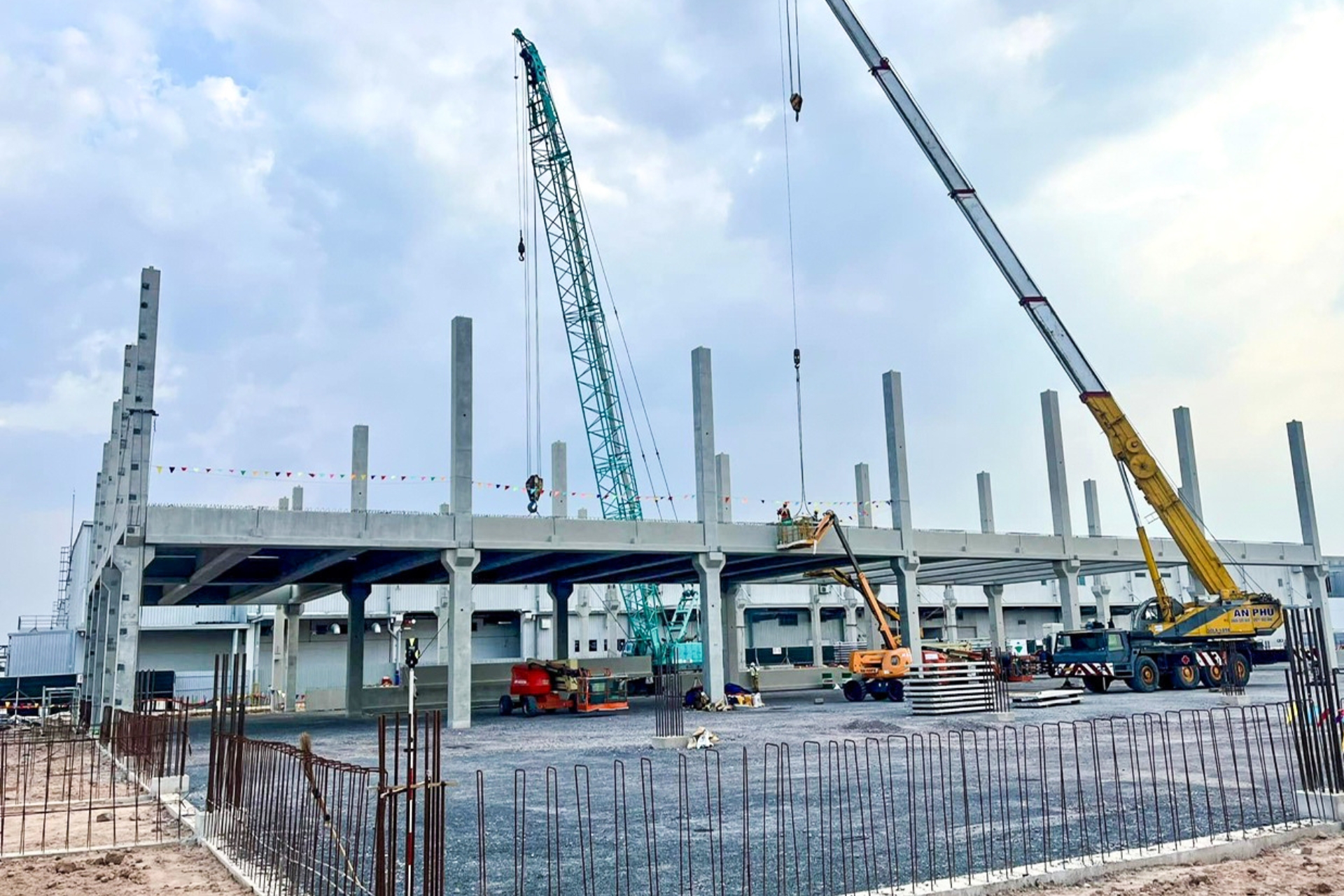 Environmental impact and occupational safety of the two solutions
Conclusion
No single solution is absolutely optimal for all projects. The choice between precast concrete components and cast-in-place concrete should be based on various factors such as:
-
Project scale and type
-
Schedule requirements
-
Investment budget
-
Long-term operational orientation
If a project requires fast progress, consistent quality, and effective risk control, precast concrete components are a highly considerable solution. Conversely, for small projects, complex forms, or renovation works, cast-in-place concrete still retains its own value.
The current trend is the flexible combination of both solutions to leverage the advantages of each method. This is also a sustainable direction in modern construction, helping optimize costs and improve project quality. Hopefully, through this article, TECO has helped enterprises clarify questions regarding these two methods.