

A Comprehensive Guide to General Hospital Design and Construction
In the context of increasingly growing healthcare demands, general hospitals not only need to meet treatment requirements. More than that, they must also ensure safety, infection control, and long-term operation. Therefore, hospital design and construction have always been a specialized field. This requires a system of standards that is much more stringent than those applied to conventional civil buildings. Let TECO explore the standards for the design and construction of general hospitals through the article below.
Why do general hospitals require separate design and construction standards?
Hospitals are places with a high concentration of patients, medical staff, and specialized technical equipment. Any mistake in design or construction can directly affect human health, and even human lives.
Unlike commercial buildings, hospital design and construction must simultaneously solve many complex problems: clean–dirty zoning, cross-infection control, 24/7 emergency operation, and flexible expansion across different development stages. In addition, general hospitals integrate many different functional departments. Each area has its own specific technical standards, which cannot be applied mechanically or uniformly.
Therefore, the system of standards in hospital design and construction is established to ensure three core factors: medical safety, operational efficiency, and long-term sustainability.

Why do general hospitals need to establish separate design and construction standards?
Vietnamese standards in hospital design and construction
In Vietnam, hospital design and construction must strictly comply with the system of standards issued by authorities such as the Ministry of Health and the Ministry of Construction. A typical example is TCVN 4470:2012 on the design and construction of general hospitals. Several important documents can be mentioned, including the National Technical Regulation on Medical Buildings and TCVN standards related to ventilation, lighting, water supply and drainage, and fire prevention and fighting.
These standards clearly specify the minimum area for each functional room, safe distances between zones, requirements for load-bearing structures, vibration resistance, waterproofing, and sound insulation. In particular, sensitive spaces such as operating rooms, ICUs, and isolation areas must comply with much stricter levels of control.
Compliance with Vietnamese standards is not only a mandatory legal requirement. It is also the foundation for hospitals to be licensed for operation and to run safely.
International standards in hospital design and construction
In addition to domestic standards, many hospital design and construction projects today also reference international standards such as FGI (USA), HTM (UK), or WHO guidelines. These standards place strong emphasis on patient experience, infection control safety, and optimization of medical operational workflows.
International standards often require clearer functional zoning, one-way circulation control, and enhanced technological solutions in building management. For private hospitals and international hospitals, applying international standards helps enhance reputation, service quality, and competitiveness.
 International standards in hospital design and construction
Standards for general hospital master planning
Master planning is a foundational step in hospital design and construction. The layout of a general hospital must be organized scientifically to ensure smooth internal circulation and minimize unnecessary intersections.
Functional zones are usually clearly separated between outpatient examination areas, inpatient treatment areas, technical and professional zones, and administrative areas. Circulation flows for patients, medical staff, visitors, and medical waste transportation must be designed independently to minimize the risk of infection.
In addition, planning must also consider future expansion. A hospital that is well designed from the outset will be easier to upgrade without disrupting medical examination and treatment activities.
 Standards for general hospital layout planning
Technical system standards in hospital construction
Technical systems play a vital role in hospital design and construction. Systems such as electrical, water supply, medical gas, and ventilation must operate stably and continuously 24/7.
In particular, the HVAC system in hospitals is not only for cooling. It also helps control pressure and air cleanliness in special areas such as operating rooms and intensive care units. The electrical system must have backup power sources and clearly defined priority levels for critical areas.
Construction of technical systems requires high precision. This demands close coordination among disciplines from the design stage to avoid conflicts and operational errors.
Material standards in general hospital construction
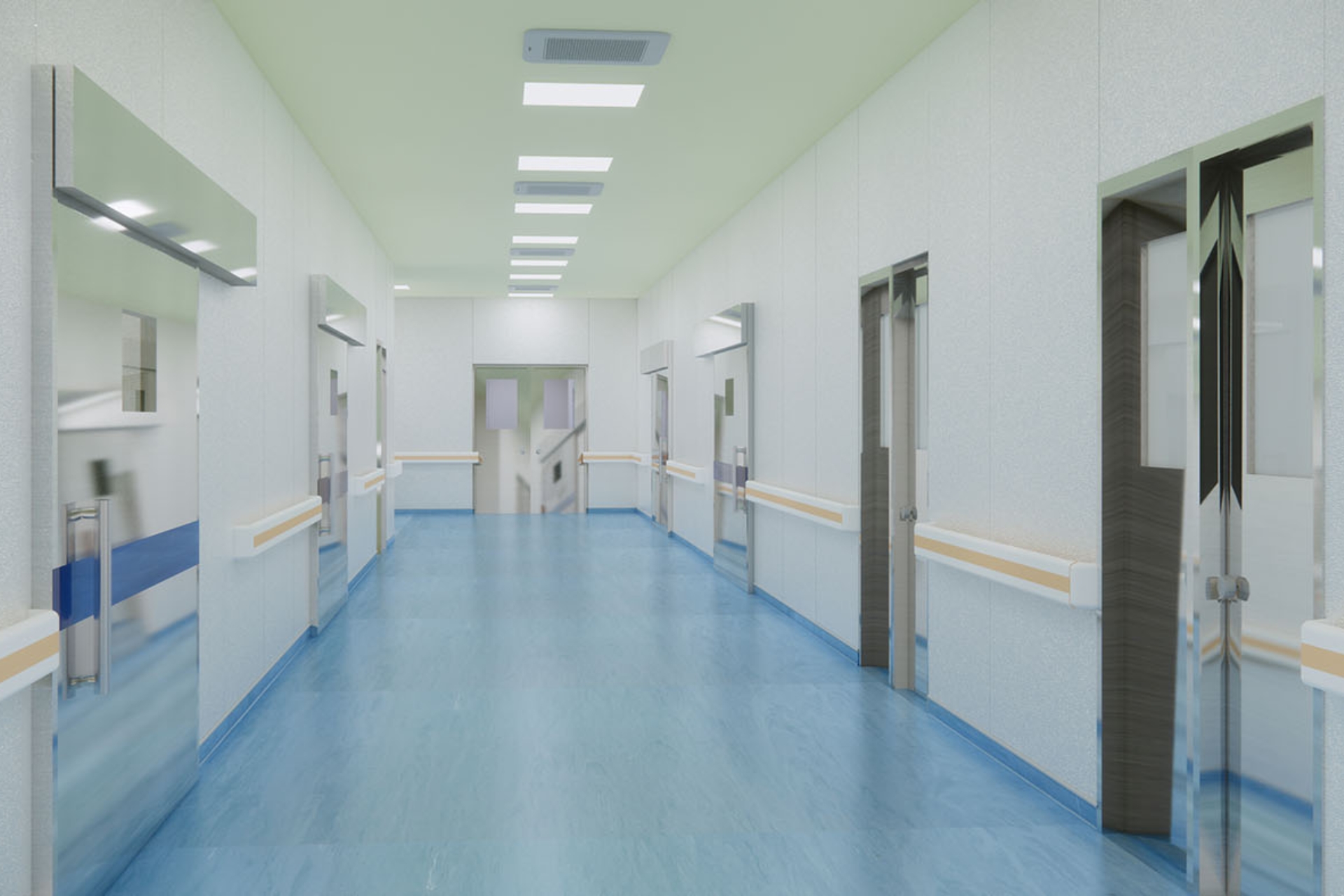
Materials used in hospital design and construction must meet high requirements for durability, cleanability, and user safety. Frequently touched surfaces such as floors, walls, and ceilings must be easy to clean, resistant to dirt accumulation, and limit bacterial growth.
Finishing materials must also ensure slip resistance, fire resistance, and no emission of toxic substances. For surgical and special treatment areas, materials must additionally meet strict sterile standards.
Choosing the right materials helps reduce maintenance costs and extend the lifespan of the facility.
 Material standards in hospital construction
Construction standards and quality control
Construction quality directly determines the safety and operational efficiency of hospitals. In hospital design and construction, quality control processes must be applied throughout, from foundations to finishing.
Overall layout organization
The overall layout must be clear and easy to navigate, minimizing overlap in circulation flows. This helps hospitals operate smoothly and reduces pressure on medical staff.
Spatial functionality
Each space in a hospital has its own function. This requires design that meets both functional requirements and standard area criteria. Proper layout helps improve work efficiency and patient experience.
Emergency department
The emergency department must be located in the most accessible position. It should enable quick connections to diagnostic imaging departments and operating rooms. The design must ensure fast, safe, and uninterrupted operations.
Outpatient clinics
Outpatient areas need to be well ventilated and sufficiently lit, while separating waiting areas to reduce patient stress. Circulation must be clear to avoid congestion during peak hours.
Inpatient wards
Inpatient rooms must ensure quietness, privacy, and convenience for care. Reasonable design supports the patient recovery process.
Operating rooms
Operating rooms are the areas with the highest standards in hospital design and construction. Requirements for sterile control, pressure regulation, and technical systems must be strictly inspected and verified.
Paraclinical areas
Laboratories and diagnostic imaging departments should be arranged close to treatment areas to shorten movement time and professional processing.
Reception lobby, waiting areas, and registration zones
Reception spaces are the first point of contact for hospitals. The design should be friendly, clear, and help reduce stress for patients.
Conclusion
Hospital design and construction are not simply about building a structure. They are about creating a safe, efficient, and humane healthcare ecosystem. Fully complying with standards from the very beginning is the key to sustainable hospital operation and long-term development. Hopefully, through the article above, TECO has helped answer questions related to the design and construction of general hospitals.